
Executive Summary
The federal courts were built to protect Americans from concentrated power. But increasingly, they protect concentrated power from Americans. Most of us still picture the federal courts the way we learned about them in civics class: robed, remote, and above the fray. We think of the one branch of government that answers to the law instead of to money. Those days are over; corporate influence has corrupted the judiciary.
Over four decades, quietly and deliberately, a new cohort of pro-corporate judges has remade the federal bench. What was once a small-“c” conservative institution has become something most Americans have never been told about: a shameless protector of the Oligarchy with a capital “O.” These judges are no longer constrained by precedent so much as by their own creativity in reaching the outcome they wanted even before the first brief was filed.
As this report reveals, the federal judiciary is not a neutral umpire, calling balls and strikes. Nor is it the last bastion of protection for everyday Americans, standing between everyday people on the one hand and corporate abuse and government overreach on the other.
This shift was no accident. In fact, as this report reveals, weaponizing the courts to enable the Oligarchy was a calculated, purposeful plan to turn back the clock on the New Deal and Civil Rights eras, a plan to undo changes that had made America a more just and equal country—a country that had just begun to fulfill the promises of the Declaration of Independence. One of the architects of the plan was none other than future Supreme Court Justice Lewis F. Powell, who drafted a memo for the U.S. Chamber of Commerce in 1971, outlining a strategy of investing in pro-business politicians, litigation, public relations, and education. Decades later, the pro-business plan had grown to encompass a full frontal assault on “liberalism” in all three branches of government, funded by America’s biggest businesses and extremists like Leonard Leo. Today, powerful, moneyed interests not only fight to win at the ballot box, in the halls of Congress, and with the regulators whose job it is to protect Americans, but they also fight and win in the courts.
This report demonstrates how investments in the Federalist Society, in judicial “Law and Economics” education, and in electoral politics have produced a federal bench that more reliably advances the interests of the wealthiest and most powerful than the interests of hardworking American families. Reviewing key cases from 10 lower court judges, this report highlights how the courts have been active in rewriting the rules to benefit giant corporations and powerful billionaires, whether those rules were meant to raise our wages, keep corporations from getting too powerful, ensure we can access affordable healthcare, or join together with fellow employees to form a union. Ruling by ruling, the Oligarchy is working through the courts to turn back the clock — to undermine the very regulations that produced a half century of increasing equality and prosperity for U.S. workers.
Though many view the courts as defenders of our democracy — the branch of government that gave us Brown v. Board of Education and Miranda v. Arizona — this report proves that the U.S. judiciary is no longer interested in defending rights and freedoms for everyday people. It serves the Oligarchy. Democracy requires independent, transparent, and ethical courts that don’t put profits over people. For those committed to democracy, the conclusion is clear: the judicial branch requires as much attention as the executive and legislative branches.
It is not enough to elect a president and Congress committed to democracy, accountability, and equality: we must fix the courts to ensure they are no longer dedicated to obstructing progressive reforms designed to create shared prosperity for all.
Introduction
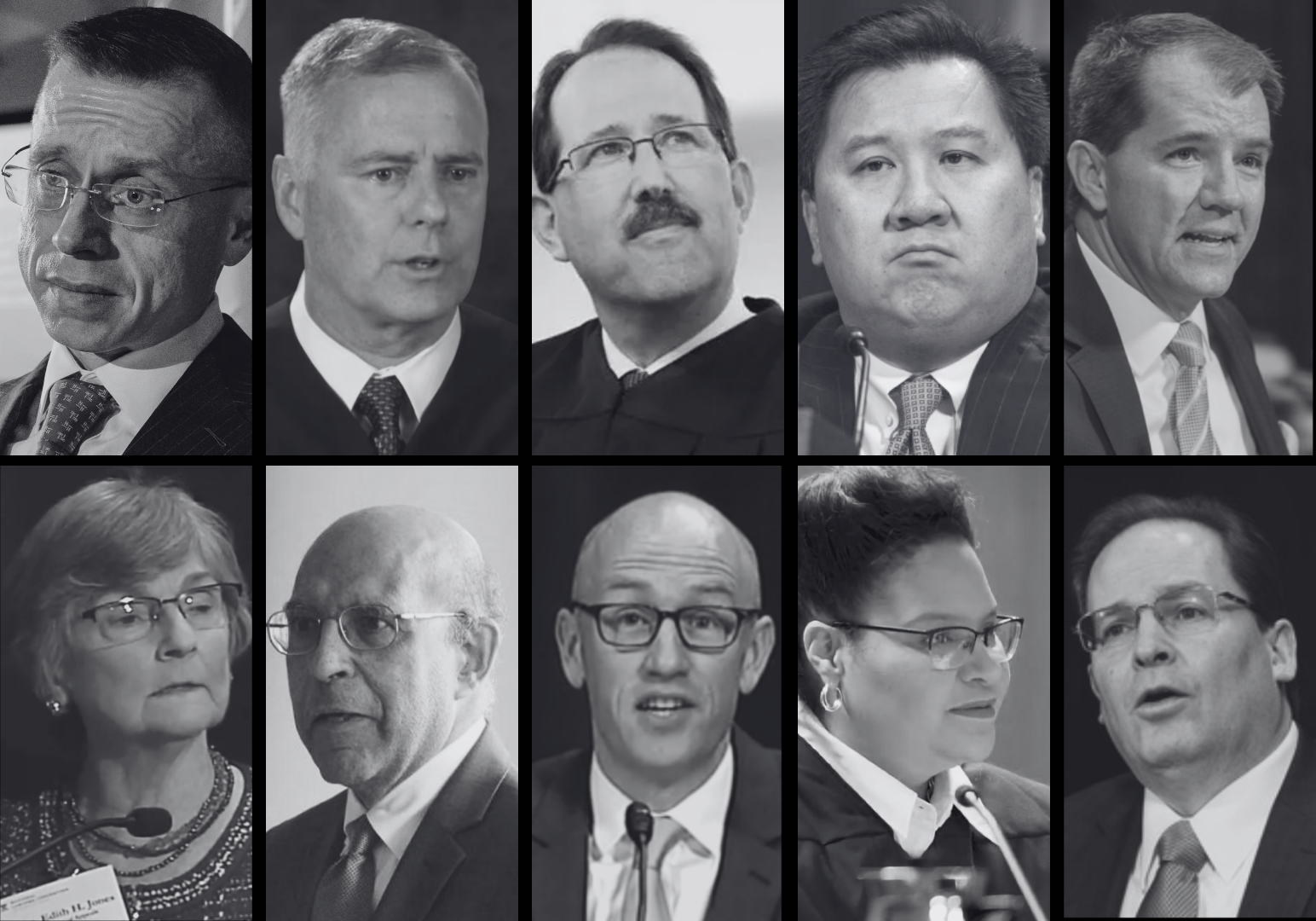
The story of America’s slide toward Oligarchy is usually told as a story of two branches: a Congress long-captured by the flood of corporate money, and a White House advancing a toxic mix of corruption, cronyism, and authoritarianism. Yet it’s the third branch, the one Alexander Hamilton erroneously called “the least dangerous,” that’s been quietly expanding and enabling this slide. Our research finds that federal judges, ruling by ruling, are dismantling the laws that restrain corporate exploitation of workers, unleashing corporate money into our politics, stripping healthcare from working families, and shifting wealth and power from the many to the few. The findings are disturbing: federal courts haven’t merely failed to stop the rigging of the American economy — they’ve helped engineer it. This report examines 10 judges at the federal district and circuit courts whose decisions arguably have done the most to empower the already powerful and enrich the already wealthy. ¹
Rigged: How Concentrated Wealth Captured the Courts
Engineering of this scale does not happen by accident. It requires money, institutions, and time, and the American Oligarchy has had all three. The story of how the federal courts came to do this work is a story of patient capital, a deliberately built pipeline, and a strategy that the right-wing Federalist Society did not invent, but did perfect.
The Pipeline
The system works the way any well-engineered system does: predictably. Billionaire donors fund the Federalist Society and Leonard Leo‘s dark-money network. Those organizations select and groom judicial nominees. Presidents appoint them. The Senate confirms them. And once on the bench with lifetime tenure, those judges set about dismantling the laws, agencies, and frameworks that protect working people, consumers, communities, and small businesses from corporate power.
This pipeline did not begin with Donald Trump. It traces back at least to 1971, when a corporate lawyer named Lewis Powell — soon to be a Supreme Court Justice — wrote a confidential memo to the U.S. Chamber of Commerce that would become the founding document of modern corporate political organizing:
Business must learn the lesson . . . that political power is necessary; that such power must be assiduously cultivated; and that when necessary, it must be used aggressively and with determination — without embarrassment and without the reluctance which has been so characteristic of American business.
American business took the lesson. Over the next half century, it built infrastructure to seek power in Congress, the White House, and, most consequentially, the courts, with the explicit aim of unwinding the gains of the New Deal and Civil Rights eras. This infrastructure includes all-expense-paid travel to conferences and other events, sponsored by organizations such as the Federalist Society, at which judges have opportunities to mingle with lawyers, law professors, law students, and fellow judges. The events are sometimes held at resort destinations such as Bar Harbor and San Diego. As the lawyer and journalist Adam Cohen wrote in Supreme Inequality, “the Court’s decisions have lifted up those who are already high and brought down those who are already low.” As this report demonstrates, this trend runs throughout the federal bench.
America does not have an Oligarchy problem because a few bad judges or litigants got lucky. It has an Oligarchy problem because a few very rich people built a machine to put committed judges exactly where they are. Veiled behind lofty words like neutrality and originalism, these judges set about unwinding policies that from the Progressive Era to the 1970s had empowered workers, created a cleaner environment, opened doors to women, people of color, and marginalized communities, and created the largest middle class the world had ever seen. This report documents that unwinding.
The Education
Not all judges whose decisions advance the Oligarchy view themselves as pro-Oligarchy. Indeed, not all come from the Federalist Society pipeline, or even from the political right. But the same interests that fund the Federalist Society’s work have found an additional way to impact court decisions to achieve the Oligarchy’s goals: education.
A view of economics known as neoliberalism, market fundamentalism, or simply “free market capitalism,” is so dominant in American political thinking that many don’t even realize there are other points of view. In the words of Nobel prize winner in economics Joseph Stiglitz, neoliberalism is not really an economic program at all. It is a political agenda that dominates mainstream economic thought and aims to reduce regulations, erode worker power, and undermine the ability of democratic societies to hold businesses accountable.
It is no accident that neoliberalism has broad reach throughout the federal bench. In 1976, in the wake of the Powell Memo and six years before the founding of the Federalist Society, Professor Henry Manne launched a “Law and Economics” training program for sitting judges. The all-expense-paid training camp “educates” (some might say “indoctrinates” because the courses have a neoliberal point of view and do not provide equal time for other types of economics) judges about economic concepts that intersect with legal questions, with an aim to infuse concepts of efficiency and incentives into legal decision making in order to overturn laws and regulations meant to protect workers and consumers. The courses, which have expanded beyond the flagship Economics Institute for Judges, have been attended and praised by Republican and Democratic appointees alike. Today, Manne’s project continues to provide intellectual scaffolding for the pro-Oligarchy bench through the Law & Economics Center at the George Mason University Antonin Scalia School of Law. The programs have received generous funding over the years from corporations, business associations, and right-wing foundations.
The training works: a rigorous 2025 study found that after attending the training, judges used more economic language in their opinions and tended to rule against regulatory agencies more often, leaving everyday Americans less protected. A key success of the Law and Economics movement has been the undermining of antitrust laws, which were written to promote competition and constrain the power of monopolies. Judges under the influence of Law and Economics effectively rewrote antitrust laws to the point that monopolies were viewed as good things. Congress didn’t rewrite these laws. But in a rightward slide, the courts did. And the results have benefitted the giant corporations and the wealthiest among us, while reducing competition, making it harder to get a raise, and leaving consumers with fewer options.
The Scale
The numbers tell a coherent story. The top 0.1% of Americans now hold more wealth than the bottom 50% combined. CEO-to-worker pay ratios have exploded from 21:1 in 1965 to more than 312:1 today. In 2024 alone, roughly 150 billionaire families spent nearly $2 billion on political campaigns.
The federal judiciary is the mechanism that locks these disparities into place. It strikes down attempts to rebalance the scales. It limits the ways Americans can organize to hold corporations accountable — gutting class actions, forcing injured consumers into private arbitration, and making it harder for working people to form and join unions. The resulting inequality is not the product of impersonal market forces. It is the product of specific decisions, made by specific judges, in published opinions.
The Location
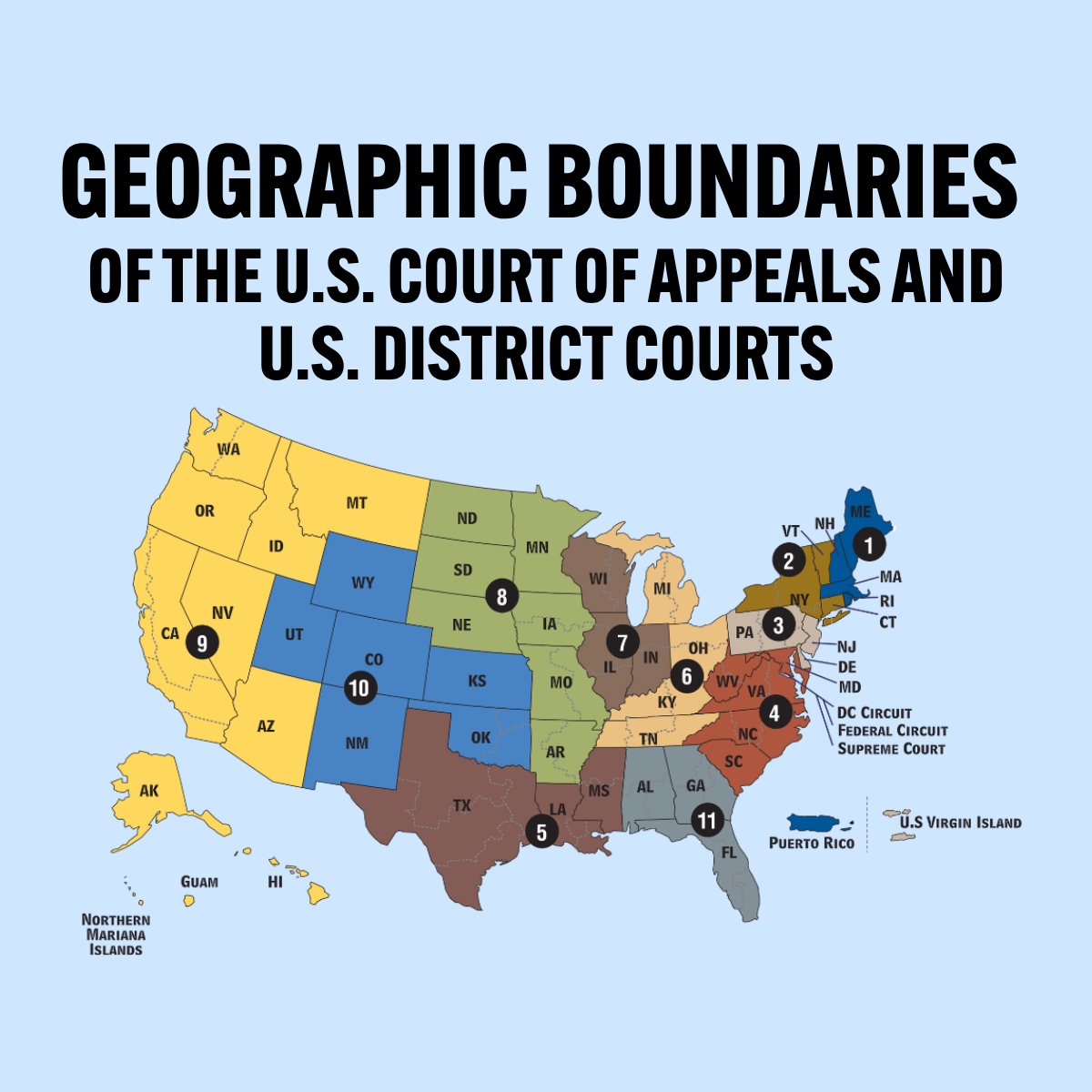
Lawyers have a name for location-based litigation strategies: forum shopping, and its more aggressive variant, judge shopping. The first plays on the geography of the federal judiciary: file in a friendly district inside a friendly circuit, like the Fifth Circuit, to guarantee a sympathetic panel on appeal. The second is more brazen. By filing a case in a single-judge division of certain districts, most notoriously in the Northern and Eastern Districts of Texas, a plaintiff can actually choose which judge will hear the case—reversing the normal process in which the assignment of a judge is random. From there, a single judge can block a federal regulation nationwide for everyone. Business interests have used this playbook again and again to attack rules that would raise pay for workers, lower fees charged by credit card companies, and combat discrimination by banks.
The result is a quiet inversion of democratic accountability. Without personal or political consequence, a handful of ideologically-aligned judges in a single corner of the country have vetoed and dismantled worker protections, consumer safeguards, and environmental rules for more than 340 million Americans.
The Time Machine
All of this is done in the name of “economic freedom,” but looking deeper, what’s really being protected is the freedom of big business to operate without regard to the life, health, and economic security of their employees, customers, or neighbors. In other words, the freedom to wield great power, but without accountability.
This inversion of accountability has echoes in America’s past. After the Civil War, the American people enacted the 13th, 14th, and 15th Amendments (known as the Reconstruction Amendments) to abolish slavery, ensure due process and equality, and guarantee voting rights. But the Supreme Court, pursuing the interests of big business, interpreted the due process clause to strike down efforts to protect working people. During this period—known as the “Lochner Era,” after a prominent 1905 case—the Supreme Court struck down a host of state and federal laws establishing minimum wages and maximum hours, combatting child labor, and securing the right of workers to organize and join unions.
As this report will show, the Federalist Society, Leonard Leo, corporate America, and their allies are establishing a second Lochner era—a period in which, under the guise of protecting Americans from government overreach, federal courts are instead protecting corporate and wealthy elites from accountability and responsibility for their actions.
The Results
For giant corporations, the time and money have paid off many times over, and the numbers are overwhelming. The Biden administration provides a stark example: in a Columbia Center for Law and the Economy study of 45 major rules implemented by that Administration, 34 were challenged in court. Of those, none survived in full: 11 were completely invalidated, 10 were partially invalidated, 13 were held in abeyance, stayed, voluntarily dismissed, or withdrawn by the Trump administration before a final ruling, and one was overturned by Congress.
Even more important are the qualitative effects: Working people blocked from organizing unions. Overtime protections struck down. Consumer watchdogs defanged. Monopolies left intact. Student debt relief denied. Non-compete bans overturned. Punitive damages limited. Class action cases obstructed.
Over more than a century, our democracy built a system for corporate oversight and accountability to hold back abuses wrought by concentrated wealth and power. It’s now being dismantled judge by judge, ruling by ruling. Not by accident. Not by Congress. By judicial fiat.
Congress can and must act to create a judiciary that stands with us, not with the corporations and wealthy elites.
Criteria: What Kinds of Decisions Enable the Oligarchy?
Our approach identifies the tools and strategies used by the Oligarchy’s bench to protect the billionaire class and giant corporations at the expense of working people. The result? The systematic undermining and elimination of the laws, rules, and legal tools necessary to prevent corporate greed from corrupting our healthcare system, economy, environmental standards, personal rights, and retirement security. The judges highlighted in this report have each written one or more significant decisions that enable the Oligarchy.
The types of rulings that enable the Oligarchy tend to fall into one or more of the following categories:
- Money and Power: rulings that further empower wealthy elites, such as by equating corporate spending with speech, striking down campaign finance limits, treating rights for corporations as indistinguishable from rights for human beings, or enabling dark money in politics.
- Regulatory Dismantling: rulings that weaken or destroy the agencies that protect workers, consumers, and the environment from corporate exploitation.
- Stripping the Safety Net: rulings that gut healthcare, preventive care, or social programs that working families depend on.
- Corporate Shield: decisions that grant corporations immunity, block the ability of government to hold powerful actors accountable, or make it harder for workers to stand up for themselves, including by organizing and joining unions.
- Executive Deference: decisions that work to expand Presidential power and immunity, particularly—or only—when that power is exercised on behalf of economic elites.
Finally, through the use of Forum Shopping and Judge Shopping, litigants can increase their chances of securing a pro-Oligarchy outcome. Rather than taking the luck of the draw as to which judge is assigned to which case, litigants looking for a more assured outcome will often file in a division, district, or circuit known to produce decisions that reliably serve the interests of economic elites and are part of the Federalist Society/Leonard Leo/billionaire pipeline.
One More Thing
The judges featured in this report are merely examples that illustrate how widespread the problem really is. They are by no means the only judges whose decisions favor the economically powerful over the rest of us. However, no matter which ten someone picks, it is critical to recognize that the judicial branch is not coming to “save democracy” or protect us from abuses by massive corporations or wannabe autocrats. Just as we work to elect presidents, senators, and representatives who we believe will do the right thing, we must work to reform the courts so they stop privileging the oligarchs.
10 Judges Enabling the Slide Toward Oligarchy
What distinguishes the judges on this list is the impact of their pro-Oligarchy rulings. Sometimes a pro-Oligarchy decision is easily identified: it results in unchecked and uncheckable use of executive power, is based on a fringe legal theory advanced by political operatives, or argues for a return to outmoded and discredited legal theories that benefit powerful elites. Other times, it’s the combined impact of several seemingly minor decisions that slowly erode power and protections from the people—putting that power in the hands of corporations, the wealthy, and unchecked executive and judicial branches.
Here, we list ten Oligarchy-enabling judges chosen for the scale of impact their rulings had on working people, the benefit delivered to concentrated wealth and corporate power, and the sheer audacity of the decisions in failing to protect everyday Americans.
#1
Judge Andrew Oldham
U.S. Court of Appeals, 5th Circuit • Appointed 2018 by Trump
Short Bio: Judge Oldham, a Harvard Law School graduate, has been a member of the Federalist Society since 2002. His post-law school jobs included serving as deputy solicitor general for Texas and general counsel to Texas Gov. Greg Abbott.
At the time of his nomination, the 39-year-old Oldham was the youngest Trump circuit judge nominee. His pro-Oligarchy decisions have tended toward regulatory dismantling and shielding corporations from accountability. While other judges attack specific regulations, Oldham has attacked the constitutional legitimacy of regulation itself. His decisions degrade the ability of the federal government to protect Americans from the powers of the elites. By arguing that regulations are illegitimate, he frees corporations from accountability to workers, consumers, and the environment.
Oldham’s Record:
Regulatory Dismantling: Questioning the Legitimacy of Independent Agencies
Oldham brought his animus toward the “administrative state” into a simple dispute between a union and an employer. In a 2020 case involving allegations an employer refused to bargain in good faith and retaliated against employees, the National Labor Relations Board (NLRB) originally ruled for the employer. The NLRB later reopened the case when it learned a conflict of interest should have kept one of the Board members off the panel. In the subsequent decision, the NLRB ruled against the employer, ExxonMobil, which challenged the decision in the Fifth Circuit. ExxonMobil lost again and sought a rehearing en banc (that is, it wanted its case heard in front of 17 judges instead of just three).
Oldham wrote a dissent from the decision not to rehear the case, claiming that there are “constitutional problems associated with so-called independent agencies” and identified “cracks in the theoretical foundation for independent agencies.” It is important to note that independent agencies such as the NLRB and the Federal Trade Commission (FTC) play critical roles in protecting workers and consumers. Oldham’s opinion challenging these agencies helped to set the stage for the Supreme Court’s decision in Trump v. Slaughter, which gives a president the unfettered right to fire members of independent agencies at will.
ExxonMobil v. NLRB, 163 F.4th 140 (5th Cir. 2025) (Oldham, dissenting from the denial of rehearing en banc).
Corporate Shield: Opposing Mandatory Disclosure Rules
A 2024 Oldham decision put everyday people saving for retirement at greater risk by undermining an important tool the Securities Exchange Commission (SEC) uses to protect investors: mandated disclosures. Oldham concluded that the SEC lacked authority to approve a rule requiring companies listed on the Nasdaq stock exchange to report on the diversity of their boards of directors, writing that such disclosures do not “protect[] investors or the public from … speculation, manipulation, fraud, anticompetitive exchange behavior.” The ruling failed to credit evidence linking board diversity with stronger financial reporting, investor protections, public disclosures, internal controls, and management oversight. Not only can the public no longer rely on standard diversity disclosures among Nasdaq-listed firms, but Oldham’s opinion provides a blueprint for pro-Oligarchy challengers to target other disclosure mandates, such as human capital and climate-related reports.
Alliance for Fair Board Recruitment v. SEC, 125 F.4th 159 (5th Cir. 2024) (en banc).
Regulatory Dismantling: Advocating to Eliminate Labor & Environmental Protections
In 2016, Oldham gave remarks at an event sponsored by the Federalist Society in which he argued that the entire U.S. regulatory system is “illegitimate,” saying, “It’s not that I disagree with a particular Department of Labor regulation or a particular IRS regulation. It is the entire existence of this edifice of administrative law [that] is constitutionally suspect.” Later in the same event, Oldham argued that “one of the reasons why the administrative state is enraging is not that you disagree with what the EPA does, although I do disagree with a lot of what it does . . . that’s not the thing that makes it enraging. It’s the illegitimacy of it.”
Remarks on the “The Texas Plan for Amending the Constitution and Restoring the Rule of Law,” delivered to an event sponsored by the Federalist Society at the University of Chicago School of Law when Oldham was deputy general counsel to Texas Governor Greg Abbott.
Impact on Working People? Systemic
Oldham’s position that the “administrative state” is illegitimate would, if fully realized, eliminate the EPA, DOL, Consumer Financial Protection Bureau (CFPB), Occupational Safety and Health Administration(OSHA), and virtually every agency that protects workers from abusive and unsafe conditions, consumers from fraud, and communities from pollution.
Benefit to the Oligarchy? Potentially Trillions
Oldham’s rulings obstructing corporate accountability increase corporate profits while depriving everyday people of needed protections.
#2
Chief Judge Reed O’Connor
U.S. District Court, Northern District of Texas (Fort Worth) • Appointed 2007 by G.W. Bush
Short Bio: A former advisor to Sen. John Cornyn of the Senate Judiciary Committee, CNN has called Chief Judge O’Connor “notorious for his rulings against the Affordable Care Act.” At a 2024 Federalist Society event, O’Connor was praised as “synonymous with the Federalist Society in Texas.” His pro-Oligarchy decisions have tended to strip the safety net, dismantle regulations, and shield corporations from accountability His seat in the Northern District of Texas, in a division with only active two judges, makes him a prime target for judge shoppers—so much so that The New York Times featured him in an in-depth article explaining how the Trump Department of Justice has beaten a path to his courtroom in an effort to secure favorable rulings. He has ruled against the ACA, in whole or in part, under three different legal theories. Each attempt threatens to undermine healthcare for working families while benefitting insurers and employers who seek greater profits through reduced spending on healthcare.
O’Connor’s Record:
Stripping the Safety Net: Invalidating the Affordable Care Act
Judge O’Connor ruled that the entire Affordable Care Act (ACA), which ensured 20 million more Americans were covered by health insurance, was unconstitutional because Congress zeroed out the individual mandate penalty — a theory so extreme the Supreme Court reversed it 7-2.
Texas v. United States, 340 F. Supp. 3d 579 (N.D. Tex. 2018) (initially filed as Texas v. Azar); reversed by California v. Texas, 593 U.S. 659 (2021).
Stripping the Safety Net & Regulatory Dismantling: Weakening the Affordable Care Act
In order to strike down the ACA’s requirement that insurers cover preventive care without cost-sharing, O’Connor ruled that the U.S. Preventive Services Task Force’s medical experts were unconstitutionally appointed. If the Task Force was unconstitutionally appointed, insurers would not have to cover preventive care without cost-sharing. Because O’Connor’s pro-insurer ruling was reversed, Americans continue to have access to preventive services without cost-sharing requirements. ²
Braidwood Mgmt, Inc. v. Becerra, 627 F. Supp. 3d 624 (N.D. Tex. 2022) (Memorandum Opinion and Order) and Braidwood Mgmt, Inc. v. Becerra, 666 F. Supp. 3d 613 (N.D. Tex. 2023) (Second Memorandum Opinion and Order on Remedies), reversed in relevant part by 6-3 by Kennedy v. Braidwood Mgmt, Inc., 606 U.S. 748 (2025).
Impact on Working People? 150,000,000+
The Department of Health and Human Services (HHS) estimates more than 150 million Americans benefit from the preventive care mandate O’Connor struck down. His 2018 ACA ruling, had it stood, would have stripped coverage from more than 20 million people.
Benefit to the Oligarchy? Billions in insurer profits
If preventive care mandates are permanently eliminated, insurers and self-funded employers can shift costs onto patients — thousands of dollars per family annually for cancer screenings, heart disease prevention, and prenatal care.
#3
Chief Judge Amos Mazzant
U.S. District Court, Eastern District of Texas • Appointed 2014 by Obama
Short Bio: Prior to his confirmation to the federal bench, Chief Judge Mazzant worked in private practice, served on the Fifth Circuit Court of Appeals of Texas and as a federal magistrate judge, as well as clerked for a number of federal judges. An Obama nominee, Chief Judge Mazzant’s decisions have played a key role in the conservative legal movement’s push to dismantle corporate transparency requirements and undermine efforts to raise wages. Between invalidating the Obama administration’s expansion of overtime protections that would have benefited 4.2 million American workers and ruling that the Corporate Transparency Act — a federal anti-money laundering measure — exceeded Congress’s authority, Mazzant has protected corporate power while harming working people.
Mazzant’s Record:
Regulatory Dismantling: Eliminating Overtime Pay
Siding with businesses who objected to paying their employees more, Judge Mazzant struck down a regulation that would have made millions more workers eligible for overtime pay. Traditionally, about two-thirds of salaried workers had been eligible for overtime pay under the Fair Labor Standards Act (FLSA), but the Department of Labor (DOL) failed to update the rule regularly after the 1970s, letting inflation eat away at the right to overtime. In 2016, the DOL updated the rule, raising the threshold to $47,476 annually, meaning salaried workers making less than the threshold would be compensated at time-and-a-half of their normal rate for hours worked in excess of 40 per week. This threshold would have extended overtime pay eligibility to about one-third of salaried workers, or about half the traditional level. Despite this moderate increase in the threshold, Judge Mazzant ruled that DOL had “exceeded its authority and gone too far” under the FLSA.
Nevada v. U.S. Dep’t of Labor, 275 F. Supp. 3d 795 (E.D. Tex. 2017) (permanently enjoining the rule); see also Nevada v. U.S. Dep’t of Labor, 218 F. Supp. 3d 520 (E.D. Tex. 2016) (preliminarily enjoining the rule).
Corporate Shield: Making It Harder to Combat Corporate Fraud & Tax Evasion
Judge Mazzant issued a nationwide preliminary injunction (temporarily pausing enforcement of the rule pending a final judgment) against the Corporate Transparency Act (CTA), a law designed to combat corporate financial fraud and tax evasion. According to Mazzant, Congress exceeded its authority by requiring businesses to report ownership information. He wrote, “The fact that a company is a company does not knight Congress with some supreme power to regulate them in all aspects—especially through the CTA.” By preventing enforcement of the CTA, Mazzant made it easier for corporations to operate through anonymous shell companies and get away with financial crimes. After more legal wrangling, the Trump administration issued a new rule saying American corporations did not have to report beneficial ownership information—in other words, allowing anonymous shell companies to flourish. The rule became final in August 2026.
Texas Top Cop Shop, Inc. v. Garland, 758 F. Supp. 3d 607 (E.D. Tex. 2024) (McHenry was substituted for Garland in 2025)
Impact on Working People? ~4,200,000 workers and untold millions of other Americans
An estimated 4.2 million workers lost out on the opportunity to earn overtime pay as a result of the ruling in Nevada, and untold millions of workers, retirees, investors, and taxpayers lost transparency protections against anonymous shell companies as a result of the nationwide injunction on the Corporate Transparency Act.
Benefit to the Oligarchy? Structural
The National Employment Law Project (NELP) called the overtime ruling “another gift to corporate America,” and the U.S. Chamber of Commerce celebrated it. Even more far-reaching was the gift in Texas Top Cop Shop enabling the use of anonymous shell companies to hide financial assets—this corporate secrecy enables tax evasion, provides a source of funding for terrorism and crime, and helps corporations to evade financial responsibilities to their employees and retirees.
#4
Judge James C. Ho
U.S. Court of Appeals, 5th Circuit • Appointed 2018 by Trump
Short Bio: Judge Ho clerked for Justice Clarence Thomas and was sworn in at Harlan Crow’s private library. This aspiring Supreme Court justice’s first written opinion attacked limits on political spending. His subsequent career reads like a sustained audition for the Supreme Court, where he could become the billionaire class’s most powerful ally. His pro-Oligarchy decisions have tended to support money and power, regulatory dismantling, and executive deference. His seat on the Fifth Circuit makes him a favored judge for forum shoppers.
Judge Ho’s 2025 Financial Disclosure Report reveals a pattern: 26 reimbursed trips for himself, his wife, or both—nearly half of them bankrolled by the same conservative legal network shaping the Oligarchy’s bench and the cases it considers. The Federalist Society reimbursed 11 trips. The Claremont Institute, which is actively fighting to eliminate birthright citizenship and same-sex marriage funded one. And Alliance Defending Freedom, the religious, right-wing powerhouse behind the overturning of Roe v. Wade and the defense of businesses that discriminate against same-sex couples, covered two, including a junket to Cancun.
Ho’s Record:
Money and Power & Regulatory Dismantling: Opposing Campaign Contribution Limits
At a time when most Americans believe there is too much money in politics, Judge Ho would put more money in. In explaining why he would overturn the $350 campaign contribution limit for local races in the city of Austin, Texas, Judge Ho wrote that “amorphous concerns about ‘improper influence’ or ‘access’ are too ambiguous and imprecise” to justify campaign contribution limits.
Zimmerman v. City of Austin, 881 F.3d 378 (5th Cir. 2018) (Ho, J., dissenting from denial of rehearing en banc).
Executive Deference: Supporting Summary Deportations
In criticizing the Supreme Court for blocking Trump’s summary deportation of migrants under the Alien Enemies Act, Ho objected to the district court’s expedited ruling despite ample evidence the Trump administration exploited delays in rulings in order to deport immigrants before judges could deliver orders halting such actions. Judge Ho wrote, “I worry that the disrespect [the President and other officials] have been shown will not inspire continued respect for the judiciary.”
W.M.M. v. Trump, No. 25-10534 (5th Cir. May 22, 2025) (Ho, J., concurring in a per curiam decision—a decision issued by the court without naming a specific judge as the author) (note: this case was originally known as A.A.R.P. v. Trump).
Executive Deference: Criticizing Lower Courts
This case, which involved a challenge to a potentially unconstitutional method of carrying out the death penalty, provides a key example of deference to the executive branch. In his concurrence, Ho suggested that a federal district judge had “manipulate[d] the legal process” to address “an issue of great public interest”— whether Louisiana could use the nitrogen hypoxia protocol to execute a man on death row. In lecturing the district court judge about overreach, Ho—the same judge who would have overturned Austin’s campaign $350 contribution limit—criticized the district judge’s “effort[s] to thwart the lawful political choices of the electorate.”
In re Gary Westcott, 135 F.4th 243 (5th Cir. 2025) (Ho, J., concurring in his own majority opinion).
Impact on Working People? Immeasurable
If elevated to SCOTUS, he could cement a generation of rulings unleashing corporate money, gutting regulation, and dismantling the social safety net. His extreme position on campaign finance would open floodgates for billionaire-funded elections far beyond Citizens United.
Benefit to the Oligarchy? Maximal
Instead of recognizing that elite and corporate money in politics has helped build laws and rules that favor elites and corporations, Judge Ho’s writing implies the opposite—that if we somehow shrink the ability of government to protect everyday Americans, money in politics will naturally diminish. “[I]f there is too much money in politics, it’s because there’s too much government,” he writes. He has refused to hire law students from universities that addressed campus protests in a manner with which he disagreed. He has criticized law firms for filing “liberal” amicus briefs. He has substituted his own opinion for the judgement of the heads of executive agencies, including the Secretaries of Energy and Homeland Security. And he has said the quiet part out loud, noting that judges get “much less pushback if we rule for a corporation or against the administrative state.” Each decision dismantling the ability of the government to regulate the power of corporations builds the Oligarchy while reducing the power of the people.
#5
Judge Don R. Willett
U.S. Court of Appeals, 5th Circuit • Appointed 2018 by Trump
Short Bio: Judge Willett has been a member of the Federalist Society since 1992, serving on the Board of Advisors for the Austin Lawyers Chapter since 2003. Willett served as an aide in the George W. Bush White House and sat on the Texas Supreme Court before his appointment to the federal bench. Willett might properly be considered a “philosopher-judge” of plutocracy, having authored what Reason magazine called “the most libertarian legal opinion ever written.” While other judges attack specific agencies, Willett has proposed a grand constitutional theory that economic regulation itself is illegitimate — reviving the very doctrine that courts used a century ago to block the New Deal. His framework, if adopted widely, would give courts veto power over minimum wages, labor protections, and every regulation the billionaire class dislikes, reviving the so-called Lochner Era. Willett’s decisions evince a clear hostility toward protections for everyday Americans, frequently dismantling regulations and shielding corporations from accountability.
In his 2025 Financial Disclosure Report, Willett reported being reimbursed by the Federalist Society for travel and lodging to an event in Georgia and by the George Mason University Law & Economics Center, the Koch and Exxon funded outfit that runs all-expense-paid judicial “education” seminars described in the Introduction, for travel and lodging to an event in Whitefish, Montana.
Willett’s Record:
Regulatory Dismantling: Advocating a Return to the Lochner Era
In a concurring opinion that condemned state legislatures’ power to regulate business licensure in the interest of public health and safety, Judge Willett dismissed “the Lochner bogeyman” as “a mirage” and championed “a wealth of contemporary legal scholarship [that] is reexamining Lochner, its history and correctness as a matter of constitutional law, and its place within broader originalist thought, specifically judicial protection of unenumerated rights such as economic liberty.”
Patel v. Texas Dep’t of Licensing & Regulation, 469 S.W.3d 69 (Tex. 2015) (Willett, J., concurring).
Willett wrote that judges who defer to legislatures on economic regulation “submissively uphold even the most risible encroachments” on economic liberty.
Same case, at 117-120.
Corporate Shield & Regulatory Dismantling: Unraveling Labor Protections
In a 2025 unfair labor practice case arising from the termination of employees who criticized SpaceX employment policies and its CEO Elon Musk, Willett’s decision deprived workers of their right to engage in protected, concerted activity. In the case, three employers, including trillionaire Musk’s SpaceX, fought unfair labor practice charges on the basis that the NLRB itself is unconstitutional. This is the equivalent of a child caught with his hand in the cookie jar challenging the right of his parents to even make rules.
However, Willett agreed with SpaceX, writing, “When an agency’s structure violates the separation of powers, the harm is immediate—and the remedy must be, too.” His ruling affirmed a lower injunction, or block, on the NLRB’s enforcement effort. Following the ruling, the NLRB dismissed the case against SpaceX, but the future of the critical agency remains in doubt: similar challenges to the constitutionality of the NLRB, including one led by Amazon, are working their way through other circuit courts.
Space Exploration Technologies Corp. v. NLRB, 151 F.4th 761(5th Cir. 2025).
Impact on Working People? Incalculable
The Lochner doctrine was used for decades to strike down minimum wage laws, maximum hour laws, child labor protections, and workplace safety regulations. Willett’s attempt to rehabilitate this framework provides the constitutional basis for courts to block future worker protection legislation. The potential impacts are not just economic: they are life and death.
Benefit to the Oligarchy? Foundational
Judge Willett’s writings are poised to provide the intellectual scaffolding to nullify the New Deal and allow courts to shield corporations and the wealthy against democratic regulation. Even the Texas Supreme Court’s own Chief Justice called Willett’s Patel concurrence a “wild championing of economic liberty” that unleashes “the Lochner monster.”
#6
Judge Edith H. Jones
U.S. Court of Appeals, 5th Circuit • Appointed 1985 by Reagan
Short Bio: Formerly in private practice, Judge Jones has been an anchor of the decades-long rightward shift of the Fifth Circuit. Many of Jones’s decisions have shaped the Fifth Circuit into a reliable venue for corporate interests, making the Circuit a prime target for forum shopping. She advanced a doctrinal framework that younger judges like Oldham and Ho now deploy. One of her rulings (joined by Judge Oldham) would have destroyed the CFPB—the federal agency responsible for combatting unfair, deceptive, discriminatory, or abusive financial practices—by denying the legitimacy of its funding mechanism. Jones’s decisions have tended toward the categories of corporate shield, regulatory dismantling, and executive deference.
In her 2024 Financial Disclosure Report, Judge Jones reported being reimbursed for travel and lodging for six trips. The Federalist Society footed the bill for three of the trips and the Claremont Institute for one.
Jones’s Record:
Corporate Shield: Opposing Consumer Protections
Judge Jones wrote a concurrence arguing that the CFPB’s funding mechanism is unconstitutional, asserting, “A government actor cannot exercise even its lawful authority using money the actor cannot spend.” If Jones’ position became law, it would destroy the consumer protection agency entirely.
CFPB v. All American Check Cashing, Inc., 33 F.4th 218 (5th Cir. 2022) (Jones, J., concurring, notably joined by Judge Oldham), reversed 7-2 by SCOTUS in CFPB v. Community Financial Services Ass’n of America, Ltd., 601 U.S. 416 (2024).
Executive Deference: Protecting Government Wrongdoing
Jones’s decisions have led the Fifth Circuit’s aggressive qualified immunity jurisprudence, shielding local, state and federal executive branch officials from liability for actions that violate fundamental rights. Her rulings have made it nearly impossible for victims of government abuse to hold officials accountable unless they can find an example of a government official who has already violated someone’s rights in virtually the exact same way.
Jones’s decision in Villareal v. City of Laredo took this idea to an extreme, granting qualified immunity to police officers who arrested a journalist under a facially unconstitutional provision of state law in retaliation for newsgathering and reporting activities they disliked. Even Judge Ho has noted these rulings are “widely disparaged as troubling rulings that badly undermine First Amendment rights.”
Villarreal v. City of Laredo, 94 F.4th 374 (5th Cir. 2024) (en banc), partially superseded by Villarreal v. City of Laredo, No. 20-40359 (5th Cir. 2025) (en banc); see also Morgan v. Swanson, 659 F.3d 359 (5th Cir. 2011) (en banc) (Jones, J., specially concurring)
Impact on Working People? At least 200 million consumers
Since its founding, the CFPB has returned over $21 billion to an estimated more than 205 million consumers or consumer accounts. Jones’s theory would have invalidated CFPB rules and enforcement actions, leaving payday lenders, predatory mortgage companies, and debt collectors unaccountable. In addition, her extreme views on qualified immunity expand executive power, which can be used to further benefit the Oligarchy and undermine the rights of working people.
Benefit to the Oligarchy? At least $30 billion
The CFPB estimates that by the end of 2024, the monetary compensation, principal reductions, canceled debts, and other consumer relief resulting from its enforcement and supervisory work totaled approximately $21 billion. CFPB has imposed an additional $5 billion in civil penalties, and bank account holders will save an estimated $6.1 billion in overdraft and non-sufficient funds (NSF) fees annually. Jones’s decisions have provided ammunition to the financial services industry in its quest to destroy the CFPB, and the industry would profit enormously by the CFPB’s destruction. In addition, Judge Jones’s qualified immunity rulings shield the government from financial accountability for wrongdoing.
#7
Judge Victor Marrero
U.S. District Court, Southern District of New York (Manhattan) • Appointed 1999 by Clinton
Short Bio: Before being appointed to the bench, Judge Marrero held jobs in both private practice and the public sector, including serving as U.S. Ambassador to the Organization of American States and Under Secretary of the U.S. Department of Housing and Urban Development. Marrero’s most notorious decision supports the Oligarchy by shielding corporations from monopoly rules aimed to constrain their power, providing proof that the tendency toward Oligarchy on the bench is a bipartisan one. When thirteen states and the District of Columbia — led by Democratic Attorneys General Letitia James and Xavier Becerra — sued to stop T-Mobile from swallowing Sprint, the case was about as close to a smoking gun as antitrust gets: it shrank the national wireless market from four carriers to three, eliminated the impetus for the merged corporation to keep prices low, and reducing competition for three remaining dominant firms. When the moment came to prevent this potential mega-merger, Marrero let it go through — in a decision called “one of the worst merger-enforcement mistakes in decades.”
Marrero’s Record:
Corporate Shield: Greenlighting Monopolies
Invoking the rarely credited “weakened competitor” theory to declare Sprint a failing firm that had to be absorbed, Judge Marrero approved the $26 billion T-Mobile/Sprint merger over the objection of fourteen state attorneys general. “T-Mobile has redefined itself over the past decade as a maverick,” he wrote, crediting executives’ in-court promises to keep competing aggressively. Marrero’s decision collapsed the national wireless market from four carriers to three, harming workers and consumers in the process.
New York v. Deutsche Telekom AG, 439 F. Supp. 3d 179 (S.D.N.Y. 2020).
Marrero’s decision brushed aside the states’ central evidence — including a Sprint executive’s texts about his eagerness to raise prices after the merger and his expectation that the whole industry would follow — by ruling that the companies’ promised price cuts and the states’ predicted price hikes “essentially cancel each other out.” New York Attorney General Letitia James called the outcome “bad for consumers, bad for workers, and bad for innovation.” Sprint and T-Mobile concluded their merger weeks later.
Impact on Working People? ~14,000 workers and millions of mobile customers
The Communications Workers of America (CWA) reported the merger destroyed about 9,000 jobs in just the first year, in large part due to the closure of 24% of T-Mobile’s corporate owned stores, despite T-Mobile’s promise that the merger would “create new jobs from day one.” And the job losses didn’t stop there. By the end of 2023, the combined company employed about 67,000 people, down roughly 14,000 — nearly 17% — from the two carriers’ pre-deal headcount, according to its SEC filings.
With one fewer national carrier, the more than 100 million subscribers of the combined company lost the downward price pressure the competition had supplied — exactly the harm the states warned against. T-Mobile’s price increase in 2024 led to a class action suit alleging it had violated its guarantee that certain wireless phone plans would have rates locked for life. And on July 31, 2026, T-Mobile announced another price hike: voice lines and home internet would jump $6 a month, while prices for smart watches and tablets would increase by $3 a month.
Benefit to the Oligarchy? Tens of billions in deal value; Sprint stock up 77%
Sprint’s shares soared roughly 77% on the ruling; Deutsche Telekom and SoftBank captured the value of a deal that regulators had spent two years resisting. As anti-monopoly economists noted, mergers that remove a maverick in already-concentrated industries can be counted on to reliably raise prices — which is why one prominent critique said the decision showed Bork-era antitrust doctrine had “jumped the shark.”
#8
Judge J. Campbell Barker
U.S. District Court, Eastern District of Texas (Tyler) • Appointed 2019 by Trump
Short Bio: When appointed to the bench, Judge Barker was serving as a Deputy Solicitor General of Texas. He had previously worked in private practice and for the U.S. Department of Justice. While working for the State of Texas, Barker argued that the First Amendment protects the right of businesses to discriminate on the basis of sexual orientation. He also worked to end DACA (deferred action on childhood arrivals—a program to protect undocumented immigrants whose parents brought them here as children). Barker’s pro-Oligarchy decisions have helped dismantle regulations, shielded corporations from responsibility, and made it harder for workers to organize.
In his 2024 Financial Disclosure Report, Barker reported being reimbursed for transportation, meals, and lodging for six trips, including one by the Federalist Society and two by George Mason University (one in New York City and the other in Miami, Florida).
Barker’s Record:
Corporate Shield: Empowering Big Business, Disempowering Workers
Barker vacated the “joint employer rule,” put in place by the NLRB in 2023 to protect the rights to organize and collectively bargain for millions of workers across America who work in franchise establishments or whose employers contract them out to other employers. The joint employer rule would have been the most significant expansion of collective bargaining rights in decades, allowing workers at franchises and those hired through staffing agencies to bargain directly with the giant corporations that actually control their working conditions, such as Amazon.
Barker killed the rule, siding with the pro-business Chamber of Commerce, holding the standard was “contrary to law” and “arbitrary and capricious.” The ruling ensured that corporations like McDonald’s and Amazon cannot be held jointly liable for labor violations by their franchisees and subcontractors, even when those corporations set wages, hours, and working conditions. It also ensures that the franchise model, in which billion-dollar corporations profit from workers’ labor while refusing all responsibility for their conditions, remains legally intact.
Chamber of Commerce v. NLRB, 723 F. Supp. 3d 498 (E.D. Tex. 2024)
“Actual control, not potential control, is required for employer status — including joint-employer status,” wrote Barker in support of the Trump-era 2020 rule, which effectively shields parent corporations from collective bargaining obligations and liability for their subsidiaries’ labor violations.
Impact on Working People? Millions of franchise & contract workers deprived of rights
Workers at the nation’s more than 830,000 franchise locations, plus millions more employed through staffing agencies and subcontractors, are effectively denied the ability to raise their wages through collective bargaining with the corporations that actually set their working conditions. Amazon had more than 250 open or settled NLRB cases in 2024. This ruling ensures that giant companies such as Amazon continue to avoid liability for denying rights to the workers performing core work, such as driving and warehouse work.
Benefit to the Oligarchy? $1.06 billion annually in suppressed wages
Fissured employment relationships help employers suppress wages, with contracted employees often earning 18-19 percent less than their direct hire counterparts. The Economic Policy Institute estimated that the rule would have resulted in a boost of pay to workers of $1.06 billion annually, or $20.4 million per week. It makes sense why the International Franchise Association, U.S. Chamber of Commerce, National Retail Federation, and Restaurant Law Center joined together to fight the rule: the franchise model depends on insulating parent corporations from accountability to the people who do the work. Judge Barker’s ruling provided legal support for that insulation.
#9
Judge Ada E. Brown
U.S. District Court, Northern District of Texas (Dallas) • Appointed 2019 by Trump
Short Bio: Judge Brown previously served in private practice, as an adjunct professor at Southern Methodist University Dedman School of Law, and as a Justice on the Fifth Circuit Court of Appeals of Texas. She has been a member of the Federalist Society since 2018. Her ruling nullifying the Federal Trade Commission’s non-compete ban fits the categories of regulatory dismantling and shielding corporations. By blocking the non-compete ban, Brown preserved one of the most direct mechanisms through which corporations keep wages low. Non-competes enable employers to lock workers in place, depressing their wages and benefits by limiting workers’ opportunities to take their skills elsewhere to get better pay and working conditions.
In her 2025 Financial Disclosure Report, Brown reported reimbursement for four trips, including one reimbursement by the Federalist Society.
Brown’s Record:
Regulatory Dismantling: Trapping Workers & Suppressing Wages
By setting aside (that is, nullifying) the FTC’s nationwide ban on non-compete agreements, Judge Brown protected the ability of corporations to trap an estimated 30 million workers in agreements that suppress their wages and limit their freedom to change jobs. By holding that the FTC lacked authority to issue the ban, Judge Brown prevented its enforcement, enabling wage suppression to continue for an estimated 30 million working Americans and their families.
Ryan LLC v. FTC, 746 F. Supp. 3d 369 (N.D. Tex. 2024).
In enjoining the non-compete rule, Judge Brown reached a decision opposite to an earlier case, ATS Tree Services, LLC v. FTC, which declined to block the rule. Unsurprisingly, instead of defending the rule, the Trump administration withdrew the rule entirely in 2026—siding with the Oligarchy over America’s workers.
Impact on Working People? ~30,000,000 workers
Approximately 30,000,000 workers lost out on higher wages (an estimated $400-488 billion over ten years) and lower health care costs (an estimated $194 billion over the next decade). Brown’s ruling preserved the corporate power to lock workers in place and suppress their earnings.
Benefit to the Oligarchy? Reduced competition and $400-488 billion in wages not paid
Non-compete agreements are a direct wealth transfer mechanism: they suppress worker mobility and wages while enhancing corporate profits, so each worker’s loss is a gain for the Oligarchy. The FTC also estimated that banning noncompetes would have led to 8,500 additional new businesses being formed each year—which could have helped lower prices and raise wages as a result of the increased competition for consumers and workers. The Chamber of Commerce—more interested in profits than in worker and consumer benefits—celebrated the ruling.
#10
Judge Sean D. Jordan
U.S. District Court, Eastern District of Texas (Plano) • Appointed 2019 by Trump
Short Bio: Before being appointed to the federal bench, Judge Jordan, an army veteran, worked in private practice and in the Texas Solicitor General’s office. Jordan was the first judge to apply the Supreme Court’s Loper Bright decision, which held that courts need not defer to agency decision-making they find unpersuasive. Jordan sits in Plano, in the Eastern District of Texas, a prime target for forum shoppers. Jordan’s cases tend to dismantle regulations and shield corporations from accountability. He has been a member of the Federalist Society since 2016.
Jordan’s Record:
Regulatory Dismantling & Corporate Shield: Stripping Workers of Overtime Pay
Like Judge Mazzant, Judge Jordan authored an opinion blocking a rule extending overtime pay eligibility to millions of workers. While Mazzant had blocked an Obama-era overtime rule, Jordan blocked a Biden-era overtime rule. Jordan’s opinion vacated the entire overtime expansion rule — including the phase that had already taken effect — resetting the overtime pay threshold back to $35,568 annually—just 44% of the 2024 U.S. median household income of $81,604. In invalidating the rule, Jordan called it an “unlawful exercise of agency power” and ruled that its changes to the minimum salary level were “in excess of statutory jurisdiction.” Jordan’s decision sided not only with the State of Texas, but a coalition of businesses led by the Plano Chamber of Commerce.
State of Texas v. U.S. Dep’t of Labor, No. 4:24-CV-499-SDJ (E.D. Tex. Nov. 15, 2024).
Using the Supreme Court’s Loper Bright framework to substitute his own judgment for that of DOL’s wage experts, Jordan decided that a major failing of the rule was that it would benefit too many workers (objecting that the new threshold would be set at the 35th, instead of 20th, percentile of weekly earnings of full-time, salaried workers in the South—the lowest wage region in the United States—imposing “billions in costs to employers”).
Regulatory Dismantling: Striking Down the Medical Debt Rule
Ignoring the devastating impact of medical debt on hardworking American families, Judge Jordan sided with credit bureaus and credit unions to vacate the CFPB’s medical debt rule, which aimed to make sure that high medical costs and inadequate health insurance could not ruin a family’s financial future. About 41% of American adults (about 100 million people) had some form of health care debt as of 2022. It is a leading cause of bankruptcy, reduces credit scores, makes it harder to secure a lease or mortgage, and can be used by debt collectors to coerce people into paying debts they do not owe. To end the abuse, the Biden-era CFPB issued a rule to remove medical debts from most credit reports. When the rule was challenged in 2025, Jordan sided with credit bureaus and credit unions. He vacated the Medical Debt Rule in its entirety, writing that the rule “exceed[ed] the Bureau’s statutory authority.”
Cornerstone Credit Union League v. CFPB, No. 4:2025-cv-00016 (E.D. Tex. July 11, 2025).
Impact on Working People? ~4.3 million workers and ~15 million with medical debt
The DOL estimated that about 4.3 million salaried workers would gain overtime protections when the higher threshold was fully implemented. As a result of Jordan’s decision, the salary threshold reverted to $35,568 — meaning workers earning as little as $36,000 can be classified as “exempt” from overtime pay even while they work unlimited hours. Acting Labor Secretary Su had called it “unacceptable” that these workers do the same job as hourly counterparts with no additional pay. The International Franchise Association, the same group that fought the joint employer rule, applauded the defeat of the overtime rule. The defeat of the medical debt rule means 15 million Americans will have lower credit scores than they otherwise would have and an estimated 22,000 families won’t have their mortgages approved.
Benefit to the Oligarchy? Billions a year in “free” overtime and higher consumer costs
Employers save billions annually by classifying low-paid salaried workers as “exempt” from overtime, and Jordan’s decision cemented an incentive to classify even more workers as “exempt” in order to increase their hours with no corresponding increase in pay.
This decision provided a preview of what is already happening as a result of Loper Bright: any time the DOL, Environmental Protection Agency, or Occupational Safety and Health Administration issues a rule that costs corporations money, judges like Jordan can substitute their own judgment for expert agencies. The Oligarchy no longer needs to worry about what happens when its congressional lobbying efforts fail; it can just find a friendly judge to overturn rules it doesn’t like.
In addition, debt collectors, creditors, and lenders will continue to profit from the use of medical debt to reduce credit scores: they will be able to gouge consumers with higher rents and interest rates and coerce them into paying debts they no longer owe.
Honorable Mention: Two Big Tech Enablers
As mentioned in the Introduction, whether or not judges are members of the Federalist Society or view themselves as part of a larger effort to entrench corporate power, it’s the impact of their decisions that matters. And no report on the Oligarchy’s Bench would be complete without a discussion of how the world’s biggest tech companies, Google in particular, have escaped accountability for their monopoly practices. In this section, we spotlight two judges chosen because they both recognized that Google, the third biggest company in the world, is an illegal monopoly, but chose not to dismantle the company—leaving Google’s market dominance, power, and wealth intact.
Judge Amit Mehta
Judge Mehta sits on the District Court for the District of Columbia and was appointed in 2014 by President Obama. In a case challenging Google’s monopoly as a search engine provider and the practices it employed to maintain that monopoly, Judge Mehta agreed that “Google is a monopolist, and it has acted as one to maintain its monopoly.” But he refused to break up the monopoly. Mehta did not require Google to sell its Chrome browser, spin-off its Android operating system, disgorge monopoly profits, or pay monetary penalties. Instead, the only penalties Google faces are a series of behavioral remedies that let Google continue to pay other companies (like Apple) to be the default search engine in their products.
In other words, despite the court finding that Google broke the law, it suffered no meaningful punishment and can continue many of the practices that help it dominate the market. This weak remedy not only harms Google’s competitors and potential competitors, it also harms those of us who use Google every day. Instead of investing to improve its product, Google has gotten noticeably worse as a search engine since over the years, a process journalist Cory Doctorow calls “enshittification.” Meanwhile, the Oligarchy benefitted: Google’s stock jumped 8% when the court announced there would be no divestment of assets.
United States v. Google LLC, No. 20-cv-3010 (APM) (D.D.C. Aug. 5, 2024) (liability); United States v. Google LLC, No. 20-cv-3010 (APM) (D.D.C. Dec. 5, 2025) (remedies).
Judge Leonie Brinkema
Judge Brinkema, appointed by President Clinton, sits in the Eastern District of Virginia. In a case with striking similarities to the Google search engine case, the DOJ and several states alleged that Google had a monopoly in “adtech,” short for advertising technology, meaning the software and tools used to buy, manage, and analyze the digital advertising that appears on our laptops, mobile phones, and other screens. As with the search engine monopoly, the DOJ sought to require Google to divest, or sell-off, some of its assets to promote competition. After hearing the evidence, Judge Brinkema ruled that Google violated antitrust law “by willfully acquiring and maintaining monopoly power” in two adtech markets and by “unlawfully” tying, that is, illegally exploiting control of one product to force customers to purchase another in order to restrict competition.
But when it came time to penalize Google for its illegal behavior, Brinkema, like Mehta before her, balked. Brinkema rejected the DOJ’s proposal to force Google to sell off pieces of its adtech empire. Instead, she ordered a variety of behavioral restrictions but allowed Google to keep the power and riches gained from its illicit behavior. “Judges are just blessing monopolies at this point,” wrote one observer. This wink-and-nod approach to monopolies helps build the Oligarchy while diminishing power for the rest of us.
United States v. Google LLC, No. 1:23-cv-108 (LMB/JFA) (E.D. Va. April 17, 2025) (liability); United States v. Google LLC, No. 1:23-cv-108 (LMB/JFA) (E.D. Va. Sept. 2, 2026) (remedies).
In discussing the failure of the lower courts to order meaningful remedies, one antitrust expert issued a dire warning: “Without actual structural remedies, antitrust rulings are just inconvenient speed bumps that allow Google to lock down search and ad tech markets today while using that same unchecked power to monopolize tomorrow’s AI frontier.”
Artificial intelligence products are new enough that there are few federal cases in the pipeline, but AI is already causing earthquakes in our economy, from current and future job losses, to upheavals in education and training, to massive data center investment and construction with little or no public input. Given that Gemini’s (Google’s consumer chatbot) market share grew from just 7% to nearly 30% in less than two years, the next market Google may illegally dominate is AI. Based on the outcome of these two cases, it’s unlikely that a third case will result in a different outcome without deep and structural reforms to our federal courts.
The Common Thread: A Strategic Plan to Create a Captured Judiciary
Many judges on this list were placed on the bench as a result of a decades-long campaign orchestrated by the Federalist Society and funded by a dark money network led by Leonard Leo and other billionaires. As Demos documented in its 2024 report on court capture, during his first term, Trump appointed more than a quarter of all active federal judges, including 54 appellate judges and three Supreme Court justices, “resulting in the capture of three Circuit courts and solidifying the Supreme Court’s ultraconservative supermajority.” And less than two years into his second term, Trump has added 56 more people to the bench.
Regardless of who nominated the judges we have highlighted, a consistent pattern emerges from the decisions highlighted in this report: corporate interests — which have stacked the bench — challenge laws and rules they don’t like, judges reliably deliver pro-Oligarchy rulings, and working people bear the costs. Whether it’s millions of workers losing overtime protections, millions of mobile phone users trapped in a monopoly, or millions of franchise workers denied the right to organize — the judiciary has become the Oligarchy’s steadfast ally, particularly given the failure of Congress to act to override these pro-Oligarchy decisions.
The geographic concentration is also striking: four of the ten judges sit on the Fifth Circuit, and five more sit in Texas district courts. But the problem extends far beyond one circuit. Tellingly, Judge Marrero, a Clinton appointee in New York, and Judge Mazzant, an Obama appointee in Texas, demonstrate that pro-Oligarchy decisions are not limited to judges appointed by a single party. Rulings that increase the power of gigantic corporations while taking power from the people are a bipartisan project.
To wit: when a coalition of Democratic attorneys general sued to stop T-Mobile from absorbing Sprint and collapsing the wireless market from four carriers to three, Judge Marrero didn’t rule in their favor. He waved the merger through — and Sprint’s stock jumped 77% in a day. The lesson? It’s not just who appoints the judges. It’s the entire system that treats corporate power as a good thing — or at least as too entrenched to challenge.
Congress Must Act
Congress has the power to fix the judicial system so that it answers to the people rather than corporate behemoths and billionaires.There are many ways to tackle the problem, so it’s not a lack of ideas that has hindered lower court reform — it’s lack of political will and courage. To effectively repair the damage already done to our economy and democracy, Congress must reform the courts so they enable the rights of the people and not the power of the Oligarchy.
Conclusion
In sum, billionaires fund the Federalist Society. The Federalist Society recommends the judges. Corporations fund “judicial education” projects that advance their view of the economy. Judges dismantle rules, laws, and agencies that protect working people. Corporate power grows. Wealth concentrates. Democracy erodes.
This is not justice. This is Oligarchy in judicial robes.
For further reading on this issue, see:
Adam Cohen. Supreme Inequality: The Supreme Court’s Fifty-Year Battle for a More Unjust America. Penguin Press, 2020.
Andrea Prat, Fiona Scott Morton, and Jacob Spitz. Ruling for the Rich: The Supreme Court over Time. NBER Working Paper No. 34643, January 2026.
Elliot Ash, Daniel L Chen, Suresh Naidu. Ideas Have Consequences: The Impact of Law and Economics on American Justice. The Quarterly Journal of Economics, Volume 141, Issue 1, February 2026, Pages 845–887.
Hannah Garden-Monheit, Conference on Reforming Lower Courts and the Administrative State: Table Setting Presentation, Center for Law and the Economy, Columbia Law School, September 2026.
DEMAND JUSTICE and GROUNDWORK COLLABORATIVE RESEARCH REPORT • OCTOBER 2026