A Pattern of Dishonesty and Evasion:
February 2026How President Trump’s Judicial Nominees Avoid the Truth to Secure Lifetime Appointments
Overview
A new Demand Justice report analyzed the Questions for the Record (“QFRs”) and oral testimonies submitted by President Trump’s Article III judicial nominees in 2025, finding that all 37 respondents provided answers about the 2020 election and January 6, 2021 that were dishonest or misleading.
The analysis finds that nominees’ responses appear nearly identical, with many nominees using verbatim phrasing, repeating key words, and, overall, using unusual and evasive language that’s almost entirely outside the normal, historical, and common lexicon used to describe such events.
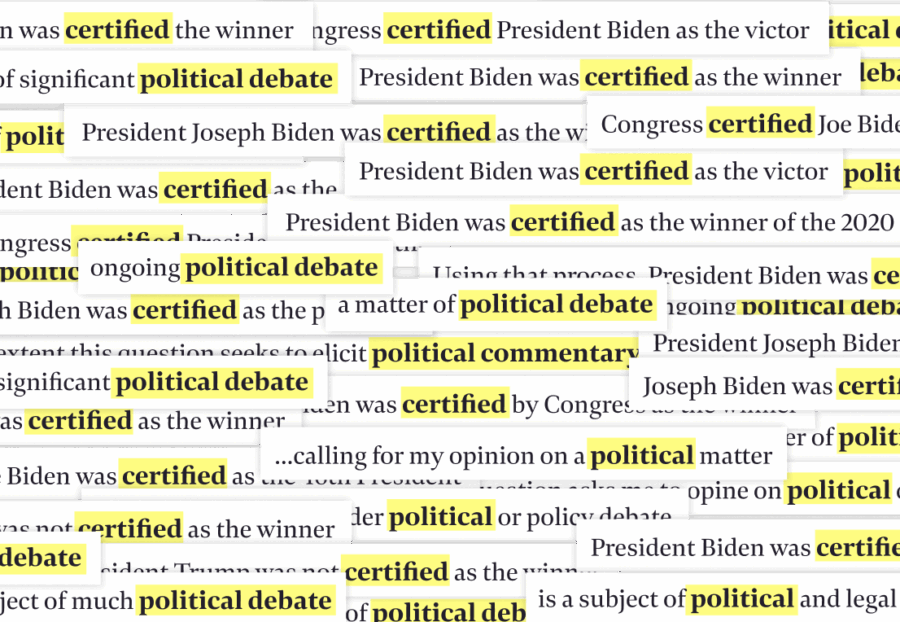
For instance, every nominee provided near-identical phrasing to avoid a direct answer about the 2020 election, instead referencing the results of the Congressional “certification” process, or answering by noting that President Biden “served” as President. And 31 of 37 nominees provided extremely similar responses in regard to January 6, often describing what transpired as a “political issue” and refusing to comment further.
All 37 nominees omitted key phrases and descriptions commonly used to describe the factual events of the 2020 election and January 6.
One now-confirmed judge – Maria Ann Lanahan – who serves on the United States District Court for the Eastern District of Missouri, responded to a question about January 6th by stating: “I was not present at the U.S. Capitol at the time. I do not have personal knowledge of the details.”
In short, not a single answer provided by the nominees on the 2020 election or January 6 was a direct, factual response – all nominees used similar language and sentence construction to avoid contradicting President Trump’s false narratives about both events.
Background
As part of the confirmation process, all nominees receive a hearing in which members of the Senate Judiciary Committee have the opportunity to ask those individuals questions. Afterwards, senators on committee are able to submit written questions to nominees after their hearing. These QFRs are another chance for senators to elicit information from nominees beyond their brief 5 minutes of in-person questioning.
Historically, judicial nominees have avoided providing direct answers on questions of unsettled law or constitutional interpretation that may come before them if confirmed. Yet, on these two subjects, President Trump’s second term judicial nominees repeatedly avoid providing answers on basic questions of documented, established, and historical fact.
Nominees have been asked numerous questions related to the 2020 election and January 6. To ensure as uniform a comparison as possible, in regard to the election, this report primarily focuses on one question that all nominees were uniformly asked: “Did Donald Trump lose the 2020 election?” In regard to January 6, we evaluated the answers to two questions, one of which at least all nominees were asked: “Was the U.S. Capitol attacked by a violent mob on January 6, 2021?,” or “Do you agree with me that the attack at the U.S. Capitol on January 6, 2021, was an insurrection? Why or why not?”
Our analysis finds that answers to these questions, as well similar ones raised during hearings and additional QFRs, are strikingly uniform. On the 2020 election: nominees’ answers use nearly identical phrasing that avoids plainly acknowledging President Biden’s victory. On January 6, responses universally fail to speak to the plain facts on what occurred during the attack on the Capitol.
Analysis – A Pattern of Evasion
2020 Election Results
All 37 nominees were asked, “Did Trump lose the 2020 election?”
- Not a single nominee was willing to state the affirmative fact that Joe Biden won the 2020 election.
- All nominees referred to the certification process as opposed to the actual results in overwhelmingly similar terms.
- Further avoiding speaking to President Biden’s victory, 22 out of 37 said only that Biden “served” as president.
- Strongly, and falsely, suggesting the results of the 2020 election are still in legal dispute, over a quarter (10 out of 37) nominees further declined to answer the question on additional grounds, typically suggesting it would be “improper” to “opine,” “express an opinion,” or be seen as “opining” on the results of the election.
- Further, 7 out of those 10 who answered in this manner used strikingly similar phrasing when starting to do so: “To the extent this question seeks…”
Key Omissions:
- 0 of the 37 nominees said that President Trump lost the 2020 election.
- 0 of the 37 nominees used other common election terms such as: popular vote or margin of victory.
- 0 of the 37 nominees said that all litigation on the election’s results had concluded many years ago and no court had found any meaningful evidence of fraud.
- 0 of the 37 nominees said that President Biden received over 300 electoral votes.
- 0 of the 37 nominees said that President Biden won the popular vote by 7 million.
The Events of January 6, 2021
For reference: All 37 nominees were asked either, “Was the U.S. Capitol attacked by a violent mob on January 6, 2021?,” or “Do you agree with me that the attack at the U.S. Capitol on January 6, 2021, was an insurrection? Why or why not?”
- Not one nominee was willing to speak to the events that occurred that day.
- 31 out of 37 of nominees characterized the events of January 6 as a political issue, using phrases such as “political debate,” “political controversy,” or “political issue.”
- Despite not being asked about this topic, 12 out of 37 raised the pardons that Trump issued for those convicted due to their actions on January 6.
- Despite the well-documented loss of life, violence, and damage committed on January 6, including the five police officers who died due to the events of the riot, only 4 of the nominees mentioned law enforcement at all.
- While all four denounced violence towards law enforcement, all but one of their answers were speaking about law enforcement generally and not tied specifically to the violence on January 6.
- Beyond the 4 nominees who denounced violence towards law enforcement, only 3 additional nominees mentioned violence on that day in any capacity.
- Over two-thirds of nominees, 25 out of 37, said it would be “improper,” “impermissible,” “inappropriate,” or “not appropriate” to comment on the events of January 6.
- Related, 31 of the 37 claimed judicial ethics rules prevented them from answering the question.
- 15 cited specifically to Canon 3(A)(6), which prohibits the discussion of pending and impending litigation despite the nature of the attack on the Capitol not being the focus of any legal dispute.
Key Omissions:
- 0 of the 37 nominees mentioned the specific law enforcement officers who died as a result of the events that occurred on January 6.
- 0 of the 37 nominees used commonsense descriptions of what happened that day: attack, trespassing, breaking and entering, destruction of property, and/or vandalism.
- 0 of the 37 nominees mentioned that the House and Senate chambers were broken into.
- 0 of the 37 nominees mentioned that the bipartisan United States House Select Committee to Investigate the January 6 attack on the United States Capitol found enough evidence to recommend that the Department of Justice indict Trump for his part in the events of January 6 and made that recommendation to the DOJ in December 2022.
- 0 of the 37 nominees mentioned the death threats the rioters directed at Mike Pence.
- 0 of the 37 nominees thanked the law enforcement officers who defended the Capitol for their bravery.
Conclusion
All Article III judges swear an oath to uphold the U.S. Constitution – ethical conduct and truthful behavior during the confirmation process is a prerequisite to that oath. Yet every nominee this year has repeated dishonest or misleading information about two historical facts, an indication that such answers are a political requirement for securing a nomination from President Trump. To date, 19 Democratic Senators have voted to confirm at least one judicial nominee who gave dishonest or misleading information about January 6 and the 2020 election.
See the nominees' full responses below:
Did Trump lose the 2020 election?
President Biden was certified as the winner of the 2020 presidential election and served as the 46th President of the United States. To the extent this question seeks to elicit an answer that could be taken as opining on the broader political debate regarding the conduct of the 2020 presidential election or on statements by any political figure, my response, consistent with the position of prior judicial nominees when asked questions regarding the 2020 election or political commentary, is that it would be improper to offer any such comment as a judicial nominee. See Code of Conduct U.S. Judges, Canon 3A(6); Canon 5.
Was the U.S. Capitol attacked by a violent mob on January 6, 2021? / Do you agree with me that the attack at the U.S. Capitol on January 6, 2021 was an insurrection? Why or why not?
Pursuant to the Judicial Canons, it would be inappropriate for me to comment on what happened on January 6, 2021, as there may be cases that will come before me involving the incidents of that day. Moreover, to the extent this question seeks to elicit political commentary it would be improper to offer any such comment as a judicial nominee. See Code of Conduct U.S. Judges, Canon 3A(6); Canon 5.
Did Trump lose the 2020 election?
Joseph Biden was certified as the winner of the 2020 election and served as the 46th President of the United States.
Was the U.S. Capitol attacked by a violent mob on January 6, 2021? / Do you agree with me that the attack at the U.S. Capitol on January 6, 2021 was an insurrection? Why or why not?
The characterization of the events on January 6, 2021, is a subject of political debate and is involved in pending or impending litigation that could come before me if I am so fortunate to be confirmed. Accordingly, as a sitting state court judge and a district court nominee, it is impermissible for me to opine on any political issues, comment on any pending or impending litigation, or forecast how I might rule in any particular case. See, e.g., Code of Conduct for U.S. Judges, Canon 3(A)(6), 5; Missouri Code of Judicial Conduct, Rule 2-2.10
Did Trump lose the 2020 election?
Under Article II and the Twelfth Amendment, Congress is responsible for counting electoral votes after a presidential election. Congress certified President Biden as the victor of the 2020 election, and he served as the 46th President of the United States.
Was the U.S. Capitol attacked by a violent mob on January 6, 2021? / Do you agree with me that the attack at the U.S. Capitol on January 6, 2021 was an insurrection? Why or why not?
I have served as a federal prosecutor both before and since January 6, 2021. Given that the United States is my client and that it was responsible for prosecuting individuals for their actions that day, it would be inappropriate for me to comment on the specific events that took place. However, I can say that violence directed toward law enforcement officers is never acceptable, and having worked for the Seante, I have a profound appreciation for the national treasure that is the United States Capitol building.
Did Trump lose the 2020 election?
President Biden was certified as the winner of the 2020 presidential election and served as the 46th President of the United States. To the extent this question seeks to elicit an answer that could be taken as opining on the broader political or policy debate regarding the conduct of the 2020 presidential election or on statements by any political figure, my response, consistent with the positions of prior judicial nominees when asked questions regarding the 2020 election, is that it would be improper to offer any such comment as a judicial nominee. See Code of Conduct of U.S. Judges, Canons 3(A)(6), 5
Was the U.S. Capitol attacked by a violent mob on January 6, 2021? / Do you agree with me that the attack at the U.S. Capitol on January 6, 2021 was an insurrection? Why or why not?
The characterization of the events on January 6, 2021 is a matter of significant political debate and subject to ongoing litigation. See, e.g., Blassingame, et al. v. Trump, No. 21 Civ. 858 (D.D.C.). Pardon recipients have also litigated the scope of the pardons in question, which is an issue that I could be required to address as a judge if I am fortunate enough to be confirmed. Thus, as a judicial nominee, it would be inappropriate to address this question.
Did Trump lose the 2020 election?
President Joseph Biden was certified as the winner of the 2020 election
Was the U.S. Capitol attacked by a violent mob on January 6, 2021? / Do you agree with me that the attack at the U.S. Capitol on January 6, 2021 was an insurrection? Why or why not?
How the events at the Capitol on January 6, 2021, are characterized was the subject of litigation in Trump v. Anderson. And the effect of pardons issued to those prosecuted for actions taken related to the events at the Capitol on January 6, 2021, is subject to ongoing litigation that could come before me if I am confirmed to serve as a district court judge. Thus, it would be inappropriate for me to address these issues. See Code of Conduct of U.S. Judges, Canon 3(A)(6).
Did Trump lose the 2020 election?
President Biden was certified as the winner of the 2020 presidential election and served as the 46th President of the United States.
Was the U.S. Capitol attacked by a violent mob on January 6, 2021? / Do you agree with me that the attack at the U.S. Capitol on January 6, 2021 was an insurrection? Why or why not?
The characterization of the events of January 6, 2021 has been the subject of much political debate. There is, likewise, continuing litigation involving those events. As a judicial nominee it would be inappropriate for me to comment on political issues as well as matters in ongoing litigation.
Did Trump lose the 2020 election?
Certification of vote by state electors determines who prevailed in a
presidential election. See U.S. Const., art. II, § 1; U.S. Const. amend. XII. Using that
process, President Biden was certified as the winner of the 2020 election
Was the U.S. Capitol attacked by a violent mob on January 6, 2021? / Do you agree with me that the attack at the U.S. Capitol on January 6, 2021 was an insurrection? Why or why not?
The Supreme Court addressed the events of January 6, 2021 in Trump v. Anderson, 601 U.S. 100, 107; 144 S.Ct. 662, 665; 218 L.Ed.2d 1 (2024), and ultimately held the Colorado Supreme Court erred in removing President Trump’s name from that state’s ballot. Otherwise, I am not aware of any precedent defining an “insurrection”.
Did Trump lose the 2020 election?
Joe Biden was certified as the winner of the 2020 election.
Was the U.S. Capitol attacked by a violent mob on January 6, 2021? / Do you agree with me that the attack at the U.S. Capitol on January 6, 2021 was an insurrection? Why or why not?
The characterization of the events on January 6, 2021, is a subject of political debate and is involved in pending or impending litigation that could come before me if I am confirmed. It is therefore inappropriate for me to characterize those events. See Code of Conduct for U.S. Judges, Canon 3(A)(6), 5.
Did Trump lose the 2020 election?
President Biden was certified as the victor and served as the 46th President of the United States.
Was the U.S. Capitol attacked by a violent mob on January 6, 2021? / Do you agree with me that the attack at the U.S. Capitol on January 6, 2021 was an insurrection? Why or why not?
The President has issued pardons to individuals involved in the events of January 6. The Supreme Court has been clear in United States v. Klein that the pardon power is one of the President’s most plenary powers. The decision whether to extend a pardon belongs to the President in his discretion. To the extent the question asks for personal political views, the judicial code of conduct prohibits any judicial nominee from providing political or policy views.
Did Trump lose the 2020 election?
President Biden was certified as the winner of the 2020 presidential election and served as the 46th President of the United States. There were various legal challenges to the results of the 2020 presidential election, and to the extent this question seeks to elicit a response about those matters or an opinion about the election in general, my answer is that it would be improper to offer any such comment as a current judicial officer. See Code of Conduct of U.S. Judges, Canons 3(A)(6), 5.
Was the U.S. Capitol attacked by a violent mob on January 6, 2021? / Do you agree with me that the attack at the U.S. Capitol on January 6, 2021 was an insurrection? Why or why not?
The question draws a legal conclusion about the events of January 6, 2021. And I am aware that the legal import of pardons issued to those prosecuted for involvement in events at the Capitol is a matter of ongoing litigation. Thus, as a current judicial officer, it would be improper to offer any further comment beyond that I condemn violence of any kind. See Code of Conduct of U.S. Judges, Canon 3(A)(6).
Did Trump lose the 2020 election?
President Biden was certified as the winner of the 2020 presidential election and served as the 46th President of the United States. To the extent this question seeks to elicit an answer that could be taken as opining on the broader political or policy debate regarding the conduct of the 2020 presidential election or on statements by any political figure, it would be improper to offer any such comment as a judicial nominee. See Code of Conduct of U.S. Judges, Canons 3(A)(6), 5.
Was the U.S. Capitol attacked by a violent mob on January 6, 2021? / Do you agree with me that the attack at the U.S. Capitol on January 6, 2021 was an insurrection? Why or why not?
Because the conduct of persons at the Capitol on January 6, 2021 is a matter of significant political debate and because the import of pardons issued to individuals prosecuted for involvement in the activities at the Capitol on January 6, 2021 is subject to ongoing litigation, it would be inappropriate for me to provide comment as a judicial nominee. See Code of Conduct of U.S. Judges, Canons 3(A)(6), 5.
Did Trump lose the 2020 election?
Congress certified President Biden as the winner of the 2020 election.
Was the U.S. Capitol attacked by a violent mob on January 6, 2021? / Do you agree with me that the attack at the U.S. Capitol on January 6, 2021 was an insurrection? Why or why not?
My response to this question would require me to express an opinion on political matters or potential future cases. Therefore, I cannot provide an answer consistent with my ethical obligations as a district court judicial nominee. See Code of Conduct for U.S. Judges, Canon 3(A)(6).
Did Trump lose the 2020 election?
President Biden was certified as the winner of the 2020 presidential election and served as the 46th President of the United States.
Was the U.S. Capitol attacked by a violent mob on January 6, 2021? / Do you agree with me that the attack at the U.S. Capitol on January 6, 2021 was an insurrection? Why or why not?
The characterization of the events at the U.S. Capitol on January 6, 2021, is a subject of political and legal debate and could come before me if I am confirmed. As a result, I cannot provide such an answer consistent with my ethical obligations as a judicial nominee. See Code of Conduct of U.S. Judges, Canons 3(A)(6), 5.
Did Trump lose the 2020 election?
Joseph Robinette Biden, Jr. was certified the winner of the 2020 election.
Was the U.S. Capitol attacked by a violent mob on January 6, 2021? / Do you agree with me that the attack at the U.S. Capitol on January 6, 2021 was an insurrection? Why or why not?
The characterization of the events at the U.S. Capitol on January 6, 2021, is a subject of political and legal debate and could come before me if I am confirmed. As a result, I cannot provide such an answer consistent with my ethical obligations as a judicial nominee. See Code of Conduct of U.S. Judges, Canons 3(A)(6), 5.
Did Trump lose the 2020 election?
President Biden was certified as the winner of the 2020 presidential election and served as the 46th President of the United States. To the extent this question seeks to elicit an answer that could be taken as opining on the broader political or policy debate regarding the conduct of the 2020 presidential election or on statements by any political figure, my response, consistent with the position of prior judicial nominees when asked questions regarding the 2020 election, is that it would be improper to offer any such comment as a judicial nominee. See Code of Conduct of U.S. Judges, Canons 3(A)(6), 5.
Was the U.S. Capitol attacked by a violent mob on January 6, 2021? / Do you agree with me that the attack at the U.S. Capitol on January 6, 2021 was an insurrection? Why or why not?
The characterization of the conduct of persons located at the Capitol on January 6, 2021, is a matter of significant political debate. In addition, I am aware that the legal import of pardons issued to those prosecuted for involvement in events at the Capitol on January 6, 2021 is a matter subject to ongoing litigation and that could come before me were I confirmed as a judge. As a judicial nominee, it would thus be inappropriate for me to provide further comment. See Code of Conduct of U.S. Judges, Canon 3A(6).
Did Trump lose the 2020 election?
The Constitution prescribes certification by Electors from the States as means for determining who prevailed in a presidential election. See U.S. Const., art. II, § 1; U.S. Const. amend. XII. Under this process, President Joseph Biden was certified as the winner of the 2020 election.
Was the U.S. Capitol attacked by a violent mob on January 6, 2021? / Do you agree with me that the attack at the U.S. Capitol on January 6, 2021 was an insurrection? Why or why not?
How the events at the Capitol on January 6, 2021, are characterized is a matter of political debate and was the subject of litigation in Trump v. Anderson. Moreover, the effect of pardons issued to those prosecuted for actions taken related to the events at the Capitol on January 6, 2021, is subject to ongoing litigation that could arise in cases that could come before me if I am confirmed to serve as a district court judge. Thus, under the Code of Conduct for United States Judges, it would be inappropriate for me to address these issues.
Did Trump lose the 2020 election?
Joseph Biden was certified as the president and served from January 2021 to January 2025.
Was the U.S. Capitol attacked by a violent mob on January 6, 2021? / Do you agree with me that the attack at the U.S. Capitol on January 6, 2021 was an insurrection? Why or why not?
I was not present at the U.S. Capitol at the time. I do not have personal knowledge of the details. Consistent with the Code of Conduct and positions taken by prior nominees, it would be inappropriate for me, as a pending judicial nominee, to comment on any subject of political controversy or to express a position regarding matters of public policy
Did Trump lose the 2020 election?
President Biden was certified as the winner of the 2020 presidential election and served as the 46th President of the United States. To the extent this question seeks to elicit an answer that could be taken as opining on the broader political or policy debate regarding the conduct of the 2020 presidential election or on statements by any political figure, my response, consistent with the position of prior judicial nominees, is that it would be improper to offer any such comment as a judicial nominee
Was the U.S. Capitol attacked by a violent mob on January 6, 2021? / Do you agree with me that the attack at the U.S. Capitol on January 6, 2021 was an insurrection? Why or why not?
The characterization of the events at the Capitol on January 6, 2021, is a topic of political and legal debate and controversy. Whether those events were an “insurrection” or “not an insurrection” has significance for application of Section 3 of the Fourteenth Amendment, an issue that has already spawned litigation and the enforcement of which is at least partially entrusted to Congress as a political branch. See Trump v. Anderson, 601 US. 100 (2024). In addition, the legal effect of pardons related to the events at the Capitol on January 6 is subject to ongoing litigation and could arise in matters pending before me if confirmed, and persons who were present at the Capitol on January 6 could appear before me as parties. More broadly, I am aware of general disputes in the public and media concerning how to describe the events of January 6. For these reasons, as a judicial nominee, it would be inappropriate for me to comment on whether the events of January 6 do or do not qualify as an “insurrection.”
Did Trump lose the 2020 election?
President Biden was certified as the victor of the Electoral College and served as the 46th President of the United States after taking the oath of office in January 2021
Was the U.S. Capitol attacked by a violent mob on January 6, 2021? / Do you agree with me that the attack at the U.S. Capitol on January 6, 2021 was an insurrection? Why or why not?
The Supreme Court in Trump v. Anderson heard arguments about whether an insurrection occurred that day and ultimately concluded that States could not forcibly remove President Trump from the ballot. To the extent the question asks for personal political views, the judicial code of conduct prohibits any judicial nominee from providing political or policy views. I will say I denounce violence in any manner.
Did Trump lose the 2020 election?
President Biden was certified the winner of the 2020 election. President Trump was certified the winner of the 2016 and 2024 elections.
Was the U.S. Capitol attacked by a violent mob on January 6, 2021? / Do you agree with me that the attack at the U.S. Capitol on January 6, 2021 was an insurrection? Why or why not?
Because the conduct of persons at the U.S. Capitol on January 6, 2021, generated significant political debate and because the import of pardons issued to individuals prosecuted for involvement in the activities at the Capitol on January 6, 2021, is subject to ongoing litigation, it would be inappropriate for me to provide comment as a judicial nominee. See Code of Conduct of U.S. Judges, Canons 3(A)(6), 5.
Did Trump lose the 2020 election?
President Biden was certified by Congress as the winner of the 2020 election. He served as President from January 2021 to January 2025.
Was the U.S. Capitol attacked by a violent mob on January 6, 2021? / Do you agree with me that the attack at the U.S. Capitol on January 6, 2021 was an insurrection? Why or why not?
The events and characterization of the conduct of persons at the Capitol on January 6, 2021, have become a topic of significant political debate. As a sitting judge and a judicial nominee, it is not appropriate for me to provide my personal views on political issues. I do not condone violence, especially directed toward law enforcement. Also, a close family member, early in her career, worked for the Sergeant at Arms for the Senate. So I have a personal and deep regard for those tasked with keeping safe the United States Capitol Building and the people who work there.
Did Trump lose the 2020 election?
Pursuant to Article II and the Twelfth Amendment, Congress certified President Biden as the victor of the 2020 election.
Was the U.S. Capitol attacked by a violent mob on January 6, 2021? / Do you agree with me that the attack at the U.S. Capitol on January 6, 2021 was an insurrection? Why or why not?
No. A provision of the U.S. Code makes it a crime for an individual who “incites, . . . assists, or engages in any rebellion or insurrection against the authority of the United States or the laws thereof, or gives aid or comfort thereto.” 18 U.S.C. § 2383. However, it does not appear that any of the defendants who were convicted for acts at the Capitol on January 6, 2021 were convicted under 18 U.S.C. § 2383.
Did Trump lose the 2020 election?
Joe Biden was certified as the winner of the 2020 presidential election and served as the 46th President of the United States
Was the U.S. Capitol attacked by a violent mob on January 6, 2021? / Do you agree with me that the attack at the U.S. Capitol on January 6, 2021 was an insurrection? Why or why not?
The characterization of the events on January 6, 2021, is a subject of intense political debate. As a judicial nominee, it is not appropriate for me to weigh in on political debates. Moreover, to the extent that the issue involves debate about legal questions, it is not appropriate for me to commit to a particular position on the matter. Finally, should I be confirmed, it is conceivable that individuals involved in those events could come before me as parties in cases related to those events. If I were to characterize those events in any way, I could be seen as having prejudged those cases, and that would be inappropriate.
Did Trump lose the 2020 election?
Joseph Biden was certified as the winner of the 2020 presidential election. To the extent that this question could be reasonably construed as calling for my opinion on a political matter, consistent with the position of prior judicial nominees I will not offer such an opinion. See Code of Conduct of U.S. Judges, Canons 3(A)(6), 5.
Was the U.S. Capitol attacked by a violent mob on January 6, 2021? / Do you agree with me that the attack at the U.S. Capitol on January 6, 2021 was an insurrection? Why or why not?
As a judicial nominee, because of the significant political debate that surrounds the events of January 6, 2021, it would be inappropriate for me to comment on whether those events are reasonably characterized as an insurrection. I also recognize that cases involving individuals prosecuted due to their involvement in the events of January 6, 2021, could be assigned to me if I am confirmed; for that reason, too, it would be inappropriate for me to comment.
Did Trump lose the 2020 election?
Joe Biden was certified as the 46th President of the United States. President Trump was certified as the 45th and 47th President. If this question asks me to comment on the broader political or policy debate regarding the 2020 presidential election, it would be inappropriate for me to do so as a judicial nominee.
Was the U.S. Capitol attacked by a violent mob on January 6, 2021? / Do you agree with me that the attack at the U.S. Capitol on January 6, 2021 was an insurrection? Why or why not?
I denounce any and all acts of violence against law enforcement and government officials; however, the characterization of the events of January 6 is subject to ongoing political debate. It would be inappropriate for me to comment on such a political debate as a judicial nominee.
Did Trump lose the 2020 election?
President Trump was not certified the winner of the 2020 election.
Was the U.S. Capitol attacked by a violent mob on January 6, 2021? / Do you agree with me that the attack at the U.S. Capitol on January 6, 2021 was an insurrection? Why or why not?
I am aware that pardons have been issued for individuals prosecuted for actions taken at the Capitol building on January 6, 2021, and that the effect of these pardons is being litigated. Further, the characterization of the events that occurred at the Capitol building on January 6, 2021, have been litigated in federal court and is the subject of political controversy. Accordingly, it would not be appropriate for me to respond to this question. See Code of Conduct of U.S. Judges, Canon 3A(6), 5.
Did Trump lose the 2020 election?
President Biden was certified the winner of the 2020 election. President Trump was certified the winner of the 2016 and 2024 elections.
Was the U.S. Capitol attacked by a violent mob on January 6, 2021? / Do you agree with me that the attack at the U.S. Capitol on January 6, 2021 was an insurrection? Why or why not?
As I am not a politician and was rarely using social media at the time, I have never expressed a public position on the events of January 6. The Supreme Court in Trump v. Anderson heard arguments about whether an insurrection occurred that day and ultimately concluded that States could not forcibly remove President Trump from the ballot. To the extent the question asks for personal political views, the judicial code of conduct prohibits any judicial nominee from providing political or policy views.
Did Trump lose the 2020 election?
President Biden was certified as the winner of the 2020 presidential election and served as the 46th President of the United States.
Was the U.S. Capitol attacked by a violent mob on January 6, 2021? / Do you agree with me that the attack at the U.S. Capitol on January 6, 2021 was an insurrection? Why or why not?
The events of January 6, 2021, are matters of significant political debate which may come before me as a Judge. Events related to January 6, 2021, are also subject to ongoing litigation. Thus, as a judicial nominee, it would be inappropriate for me to answer this question or engage in any political commentary. See Code of Conduct United States Judges, Canon 3A(6); Canon 5.
Did Trump lose the 2020 election?
President Biden was certified as the winner of the Electoral College following the 2020 election, and that certification is the constitutionally prescribed process for prevailing in a presidential election. See U.S. Const., art. II, § 1; U.S. Const. amend. XII. To the extent that this question asks me to opine on political debates surrounding the 2020 election or the statements of political figures, I must refrain from doing so, consistent with the Code of Conduct for United States Judges and Florida’s Code of Judicial Conduct.
Was the U.S. Capitol attacked by a violent mob on January 6, 2021? / Do you agree with me that the attack at the U.S. Capitol on January 6, 2021 was an insurrection? Why or why not?
I acknowledge that several individuals were convicted of violent offenses for their actions at the U.S. Capitol on January 6, 2021. However, consistent with the Code of Conduct for United States Judges and Florida’s Code of Judicial Conduct, I must avoid weighing in on political controversies and statements regarding the events that occurred at the U.S. Capitol on January 6, 2021, including this question’s characterization of those events, which has been the subject of political debate. Moreover, to the extent that this question seeks a comment on the issuance of any pardons, I similarly must decline to address the matter.
Did Trump lose the 2020 election?
President Trump was not certified as the winner of the 2020 presidential election. To the extent this question seeks a response about legal matters or an opinion about the election, it would be impermissible for me to comment as a sitting U.S. Magistrate Judge under the Code of Conduct of U.S. Judges and its judicial cannons.
Was the U.S. Capitol attacked by a violent mob on January 6, 2021? / Do you agree with me that the attack at the U.S. Capitol on January 6, 2021 was an insurrection? Why or why not?
As a sitting U.S. Magistrate Judge and district court nominee, it is impermissible for me to comment based on the Code of Conduct for United States Judges and its judicial cannons because those issues are being actively litigated.
Did Trump lose the 2020 election?
President Biden was certified as the winner of the 2020 presidential election and served four years.
Was the U.S. Capitol attacked by a violent mob on January 6, 2021? / Do you agree with me that the attack at the U.S. Capitol on January 6, 2021 was an insurrection? Why or why not?
The characterization of the events of January 6, 2021, is the subject of ongoing political and legal debate. Further, there is pending litigation relating to such events. As a result, as a sitting state court judge and judicial nominee, it would be inappropriate for me to comment. See Code of Conduct for U.S. Judges, Canons 3, 5; Arkansas Code of Judicial Conduct, Canons 2, 4.
Did Trump lose the 2020 election?
As I recall, there were various legal challenges to the results of the 2020 presidential election. Joe Biden was certified as the winner of the 2020 presidential election and served four years as president.
Was the U.S. Capitol attacked by a violent mob on January 6, 2021? / Do you agree with me that the attack at the U.S. Capitol on January 6, 2021 was an insurrection? Why or why not?
As a nominee to a U.S. District Court, I think commenting on this issue would be inappropriate, particularly considering it is a highly contested political issue from which litigation has arisen.
Did Trump lose the 2020 election?
President Biden was certified the winner of the 2020 election and served as president for four years.
Was the U.S. Capitol attacked by a violent mob on January 6, 2021? / Do you agree with me that the attack at the U.S. Capitol on January 6, 2021 was an insurrection? Why or why not?
As a judicial nominee, in the light of the significant political debate surrounding the events of January 6, 2021, it would be inappropriate for me to comment on whether those events were an insurrection. “Insurrection” is a legal term that appears in statutory law and the U.S. Constitution and whose application to those involved in the referenced events may come before me if I am confirmed, which is another reason it would be inappropriate for me to comment.
Did Trump lose the 2020 election?
President Biden was certified the winner of the 2020 election. President Trump was certified the winner of the 2016 and 2024 elections
Was the U.S. Capitol attacked by a violent mob on January 6, 2021? / Do you agree with me that the attack at the U.S. Capitol on January 6, 2021 was an insurrection? Why or why not?
The characterization of the conduct of persons located at the Capitol on January 6, 2021, is a matter of significant political debate. In addition, I am aware that the legal import of pardons issued to those prosecuted for involvement in events at the Capitol on January 6, 2021 is a matter subject to ongoing litigation and that could arise in cases were I confirmed as a judge; so too, if I am confirmed, persons present at the Capitol on January 6, 2021 could come before me as parties to future cases. As a judicial nominee it would be inappropriate to provide comments that could implicate issues or parties
Did Trump lose the 2020 election?
President Biden was certified as having won the 2020 presidential election, and served as the 46th President of the United States.
Was the U.S. Capitol attacked by a violent mob on January 6, 2021? / Do you agree with me that the attack at the U.S. Capitol on January 6, 2021 was an insurrection? Why or why not?
As a judicial nominee, I cannot comment on this question without risking violating the judicial code of conduct, as the question implicates political and policy issues that are the subject of controversy and debate.
Did Trump lose the 2020 election?
Congress certified Joe Biden as the winner of the 2020 election and he served as the 46th President of the United States.
Was the U.S. Capitol attacked by a violent mob on January 6, 2021? / Do you agree with me that the attack at the U.S. Capitol on January 6, 2021 was an insurrection? Why or why not?
The question’s characterization of the events that took place at the Capitol on January 6, 2021, and my response to it would require me to express an opinion on political matters or potential future cases. Therefore, I cannot provide an answer consistent with my ethical obligations as a district court judicial nominee. See Code of Conduct for U.S. Judges, Canon 3(A)(6).
Did Trump lose the 2020 election?
President Biden was certified as the winner of the 2020 presidential election and served four years as President of the United States.
Was the U.S. Capitol attacked by a violent mob on January 6, 2021? / Do you agree with me that the attack at the U.S. Capitol on January 6, 2021 was an insurrection? Why or why not?
I believe it would be inappropriate to comment or opine on this issue because it is a topic of significant political debate and controversy.